
AR aging report stuck at 90+ days? Clear your dental claim backlog in 30 days with this proven sprint framework. Get the week-by-week playbook DSOs use.
If your AR aging report reads like a to-do list from last quarter, you’re not alone. Dental claim backlogs balloon for even the best-run DSOs and group practices—especially after expansions, staffing changes, payer policy updates, or software migrations. The downstream effects are painful: delayed cash, stressed billing teams, and unnecessary patient escalations.
What is Dental Claim Cleanup?
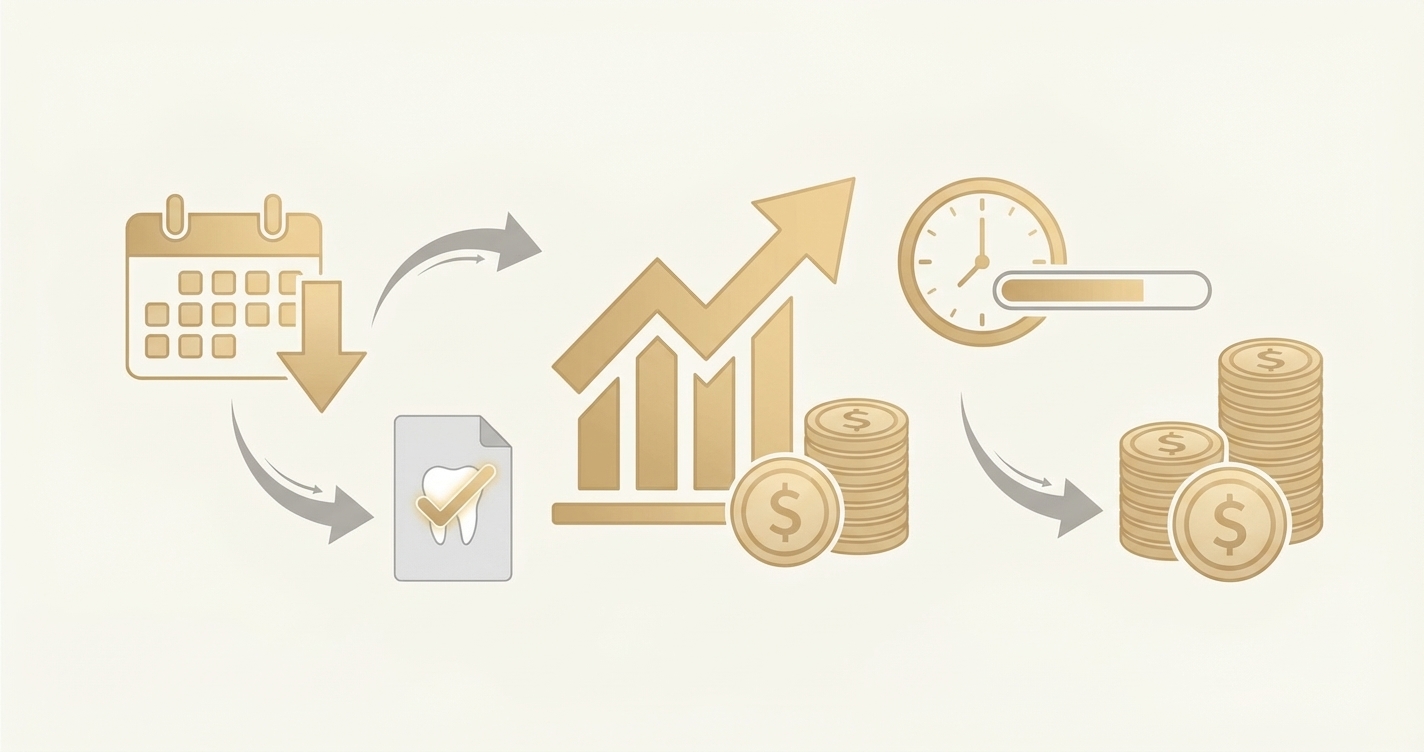
Dental claim cleanup is the structured process of identifying, prioritizing, and resolving outstanding insurance claims—status checks, documentation fixes, appeals, and collections—so practices can convert aged AR into cash quickly and sustainably. This process involves leveraging modern technologies and methodologies to handle claims efficiently. For example, a client using our system saw a 50% reduction in claim processing time, accelerating cash flow and reducing team stress.
In this in-depth guide, you’ll get a 30-day execution plan to eliminate your claim backlog without burning out staff. We’ll unpack why backlogs happen, what modern solutions look like, a side-by-side comparison of manual versus AI-assisted cleanup, and the KPIs that prove progress. You’ll also see how real organizations shortened AR cycles using AI agents as teammates, not replacements.
Why this matters now: claims are getting more complex while teams are stretched thin. The 2023 CAQH Index estimates the healthcare system (medical and dental included) could save over $25B annually by fully automating administrative transactions, including claim status, eligibility, and prior authorization (source: CAQH Index 2023). That opportunity is sitting in your backlog today.
The Hidden Cost of Claim Backlogs
Most backlogs don’t appear overnight. They accumulate in the “messy middle” of RCM—where payer portals, clearinghouse quirks, attachments, and follow-ups meet human attention limits. Typical triggers include:
- Staffing gaps or turnover in billing
- Rapid location growth without standardized workflows
- Payer policy shifts and changing attachment requirements
- EHR/PM upgrades that break prior automations or templates
- End-of-month rushes that push follow-ups to “later”
Operational impact is significant:
- Cash flow slows as claim cycles stretch from days into weeks or months.
- Aging buckets (>30, >60, >90 days) swell, requiring more rework and managerial oversight.
- Front office and billing teams spend hours on phone queues and portal logins, reducing time for higher-value tasks like denial prevention.
- Patient satisfaction drops when insurance delays cascade into unclear balances or surprise statements.
Traditional fixes—throw more people at the backlog, schedule weekend sprints, or outsource everything—often fail to scale. Manual work doesn’t keep pace with payer variability and portal hurdles such as MFA prompts and CAPTCHAs. And outsourcing can introduce delays when specialized context is required (e.g., documentation or clinical notes).
This is where AI agents integrated into your existing workflows change the equation. Teams that pair staff with Ventus AI for dental RCM automation gain always-on, browser-native teammates that log into payer portals, handle MFA/CAPTCHAs, track statuses, compile notes, and escalate edge cases to humans. Instead of asking your team to do more, you let digital coworkers do the repetitive follow-ups so your people focus on exceptions, documentation fixes, and high-dollar priorities.
DSOs with 50+ locations save 40% on RCM costs in the first 90 days.
Request an Enterprise AssessmentThree Approaches to Claim Cleanup: Manual vs RPA vs AI Agents
Modern claim cleanup solutions combine process discipline with automation. The goal isn’t to replace your team; it’s to give them leverage. Here’s what that looks like in practice:
Key capabilities to look for:
- Browser-native automation: Agents work exactly where staff work—inside payer portals, clearinghouses, and PM/EHR systems—so no APIs are required.
- Security-aware execution: Agents handle MFA prompts, CAPTCHAs, and payer security flows reliably without compromising compliance.
- Smart triage and prioritization: Backlog is ranked by age, payer, dollar value, and denial reason codes to maximize cash impact quickly.
- Denial workflows: Automated gathering of payer responses, reason codes, and required attachments; templated but customizable appeals.
- Team communication: Notifications and summaries via Slack, Microsoft Teams, and email; seamless assignment of exceptions to staff.
- Phone-call fallback: When a portal stalls, an agent can trigger or make a phone call to obtain status or resolve edge cases.
- Compliance: HIPAA compliant and SOC 2 Type II certified execution with auditable logs.
- Rapid setup: Typical deployment under 7 days so you start clearing AR this month.
How this differs from simple RPA: Instead of brittle scripts, AI agents interpret pages, adapt to new layouts, and ask for help when context is missing. They behave like junior team members who get smarter over time, not like static macros.
Manual vs AI-Assisted Cleanup: A Side-by-Side View
| Process Step | Manual Backlog Cleanup | Ventus AI Agent-Assisted Cleanup |
|---|---|---|
| Backlog Inventory | Export reports, pivot in spreadsheets | Auto-ingest from PM/EHR exports; categorize by payer, age, dollar |
| Prioritization | Manager-driven, time-consuming | Algorithmic triage; dynamic re-ranking by ROI |
| Claim Statusing | Portal logins, MFA, CAPTCHAs, queues | Browser-native agents complete status checks 24/7 |
| Denial Reason Capture | Notes copy/paste into PM | Auto-structured reason codes + notes attached to claim |
| Attachments/Appeals | Staff gather docs and draft letters | Agents assemble attachments, propose appeal templates for human approval |
| Escalation | Email or hallway chats | Slack/Teams alerts with context, due dates, and one-click assignment |
| Phone Outreach | Staff wait on hold | Agent-initiated calls for targeted payers; transcripts logged |
| Reporting | Manual weekly roll-ups | Real-time dashboards: resolved claims, dollars recovered, cycle time |
The outcome: your billing coordinators become exception-handling experts while agents handle volume. This division of labor is why dental organizations can commit to—and hit—a 30-day cleanup timeline without burnout.
The 30-Day Sprint: Week-by-Week Implementation Roadmap
A 30-day cleanup is achievable with a structured plan. Here’s a proven sprint framework you can tailor to your practice or DSO.
Week 0 (Prep – 2–3 days):
- Define scope and success metrics
- Which payers, locations, and aging buckets are in scope?
- Target metrics: backlog size, dollar value, clean claim rate, denial overturn rate, and average days in AR.
- Centralize source data
- Export claim lists from your PM/EHR with claim ID, payer, DOS, amount, denial reasons, and notes.
- Validate data quality. Flag missing attachments or documentation fields.
- Stand up your AI agents
- Configure AI agents for claim statusing and denial management to log into payer portals and your PM/EHR.
- Confirm security posture: HIPAA compliance, SOC 2 Type II, role-based access, audit trails.
- Connect Slack/Teams/email for notifications and summaries. Define escalation paths.
Week 1: Attack high-ROI slices
- Prioritize by age and dollar value: Start with >90-day claims and top-5 payers by outstanding dollars.
- Run continuous claim statusing: Agents perform portal checks in bulk, capture reason codes, and tag quick wins (missing info) versus complex denials.
- Stand up “fast fix” playbooks: Eligibility mismatches, missing X-rays or perio charts, CDT code clarification—give staff checklists and templates to resolve quickly.
Week 2: Denial drilling and appeals
- Pattern analysis: Identify repeating denial reasons by payer. Standardize documentation and appeal templates accordingly.
- Agent-assisted appeals: Agents assemble attachments from your document repository and draft appeal letters for human approval.
- Phone escalations: For payers with poor portal data, agents trigger targeted call workflows and log results so nothing is duplicated.
Week 3: Stabilize and scale
- Expand payer coverage to mid-dollar, mid-age claims.
- Reduce rework with root-cause fixes: Adjust front-desk verification scripts; update clinical documentation checklists; add CDT mapping rules.
- Daily huddles: 10–15 minutes reviewing yesterday’s clears, today’s blockers, and target metrics.
Week 4: Lock in and prevent recurrence
- Move agents from “cleanup mode” to “continuous maintenance.”
- Establish guardrails: automated alerts when claims approach 21/30/45-day thresholds.
- Retrospective: What denial reasons can be eliminated upstream? Who owns which SOP updates?
Common Mistakes to Avoid
- Boiling the ocean: Start with the 20% of claims representing 80% of dollars.
- Weak documentation: Denials linger when attachments are missing or inconsistent. Create a single source of truth.
- Over-reliance on manual spreadsheets: Use dashboards fed by live agent activity.
- Ignoring payer-specific nuance: Encode payer rules into playbooks so agents and staff act consistently.
How DSOs Are Accelerating AR Recovery
Multi-location dental groups using Ventus AI for AR follow-up during periods of rapid growth have seen dramatic improvements. "Ventus stands out from the noise in the AI and automation market. Their approach allows them to ramp up quickly in the messy middle of RCM." By deploying AI agents to handle claim statusing—executing thousands of status checks daily across their payer mix—teams free up coordinators to focus on resolving exceptions and preventing future denials. That speed wasn’t about replacing people; it was about giving the team AI-powered leverage.
Why this works operationally
- Browser-native execution: Agents navigate payer portals like a coordinator would—no API dependencies or IT waits.
- Security ready: Agents handle MFA, CAPTCHAs, and policy changes gracefully, with full audit logs.
- Human-in-the-loop: Staff approve appeals and documentation when judgment is needed; agents do the rest.
- Communication-first: Summaries and escalations flow through Slack/Teams/email so managers always know status.
- Last-mile resolution: For sticky claims, agents also support outbound calls, then synchronize notes back to your system.
ROI Reality Check: What DSOs Actually Achieve
A 30-day dental claim cleanup should produce both immediate and ongoing value. You’ll see quick cash from aged AR, plus lasting reductions in claim cycle times and rework.
Expected benefits
- Faster cash conversion: Moving claims from 60–90+ days to resolution in days, not weeks.
- Higher staff productivity: Agents absorb routine follow-ups so coordinators concentrate on high-dollar and clinical documentation issues.
- Fewer re-submissions: Standardized attachments and appeal templates reduce avoidable denials.
- Better visibility: Real-time dashboards highlight bottlenecks and payer trends.
Key metrics to track
- Backlog size and dollar value by aging bucket
- Average days in AR (by payer and procedure category)
- First-pass resolution rate and denial overturn rate
- Cycle time from status check to payment/appeal submission
- Staff time saved (hours per week) and cost-to-collect
Timeline for results
- Week 1: Visibility and quick wins on >90-day claims
- Week 2–3: Denial patterns addressed; steady cash acceleration
- Week 4: Backlog significantly reduced; prevention guardrails live
Proof points
- DSOs using dental RCM automation, demonstrating what’s possible when AI agents shoulder the repetitive work.
- System-level potential: The CAQH Index (2023) highlights billions in annual savings from automating administrative transactions across healthcare, reinforcing the ROI of an automation-first cleanup approach.
See why scaling DSOs trust Ventus AI to automate claim statusing, denials, and AR follow-up.
Request a Demo and Free RCM AuditFrequently Asked Questions
How does the dental claim cleanup process work?
The dental claim cleanup process involves identifying, prioritizing, and resolving claims systematically. AI agents assist in logging into payer portals, handling MFA/CAPTCHAs, and documenting claim statuses. This allows billing teams to focus on exceptions and high-priority claims. Teams typically see a reduction in claim processing time by up to 60% within the first month.
What are the costs and ROI of dental claim cleanup?
The costs vary based on the size of the practice and the extent of backlog. However, most practices report a rapid ROI due to increased cash flow and reduced staffing costs. By automating repetitive tasks, practices can decrease their cost-to-collect and improve financial performance.
How do we ensure compliance during the cleanup?
Compliance is ensured through HIPAA-compliant systems and SOC 2 Type II certified processes. Access is controlled by role-based permissions, and all actions are logged for audit purposes. AI agents are programmed to adhere to all regulatory standards, providing secure and compliant claim processing.
What timeline should we expect for seeing results?
Results typically start appearing within the first week, with significant backlog reduction by the end of the 30-day period. Week-by-week improvements include enhanced visibility, decreased AR days, and increased cash flow, all contributing to a streamlined revenue cycle.
What are the best practices for implementing a dental claim cleanup?
Best practices include setting clear metrics, centralizing data, and leveraging AI agents for automation. Regular communication and daily huddles help in keeping the team aligned. It's crucial to start with high-dollar claims and gradually expand to other categories, ensuring efficient use of resources.
How do AI agents differ from traditional RPA tools?
AI agents are more adaptable than traditional RPA tools. They can interpret changes in portal layouts, engage in decision-making processes, and learn over time. Unlike static scripts, AI agents provide dynamic solutions that evolve, making them ideal for complex billing environments.
What happens in edge cases where claims are difficult to resolve?
In edge cases, AI agents escalate the issue to human billers with detailed context packets. These packets include claim history, relevant documents, and next-step recommendations, ensuring that human intervention is informed and efficient. Agents can also initiate phone outreach if necessary.
How does this approach compare to other claim management solutions?
This approach stands out due to its integration of AI for intelligent automation, reducing manual effort, and improving accuracy. Compared to traditional methods, it offers faster resolution times, higher first-pass rates, and better compliance adherence, ultimately enhancing overall operational efficiency.
Your Next Move: Start Your 30-Day Sprint
Backlogs happen—even to well-run DSOs. The difference between “perpetual catch-up” and “cash flows on time” is a repeatable playbook and the right teammates. AI agents don’t replace your billing coordinators; they remove the repetitive friction so your people can focus on complex denials, accurate documentation, and patient experience.
If you’re aiming to clear your dental claim backlog in 30 days, start with scope, prioritize by ROI, and pair your team with automation built for the messy middle of RCM. Secure, browser-native agents that handle MFA, CAPTCHAs, and phone calls will keep the work moving 24/7—and keep your managers informed through Slack, Teams, and email.
Ready to see your own AR drop? Book a tailored walkthrough to plan your 30-day cleanup sprint: schedule a live demo. If you operate in medical settings as well, explore our HIPAA-compliant medical RCM automation to extend the same discipline across your organization.
Ready to Transform Your Dental RCM?
See how Ventus AI agents can automate your claim denial management and AR follow-up across all your locations in under 7 days—no complex integrations required.
Book Your Free Demo
Enterprise AI Automation for Healthcare RCM
Written by the Ventus AI team — healthcare RCM practitioners, automation engineers, and former revenue cycle leaders building AI agents that work as teammates alongside billing teams. Ventus is SOC 2 Type II certified and HIPAA compliant.