On this page
What is the dental claim process?
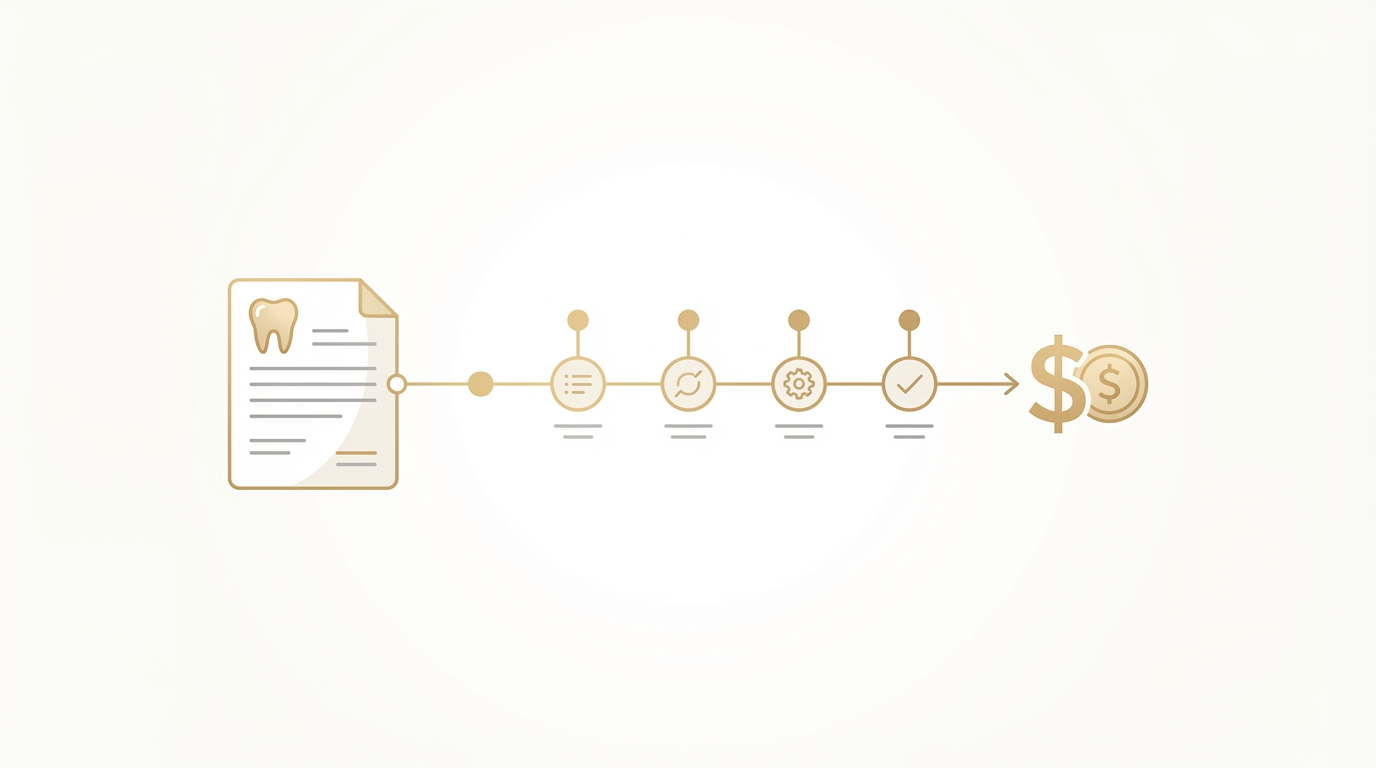
The dental claim process is the end-to-end set of steps that turns a patient visit into paid revenue—from eligibility verification and coding to claim submission, adjudication, and follow-up. When executed consistently, it reduces denials, accelerates cash, and improves patient satisfaction. For example, Smilist uses AI agents to run 3,000+ claim status checks per day, freeing staff to handle exceptions and patient conversations.
If you manage a DSO or multi-site practice, the friction points are familiar: payer portals with MFA and CAPTCHAs, phone queues, duplicate documentation requests, and unpredictable EOBs. In 2026, staffing constraints and payer policy updates make the process even harder to scale without technology. This guide breaks down each step of the dental claim process, common failure modes, three operating models (in-house, outsource, AI-assisted), and a pragmatic implementation roadmap with real results.
Why this matters now: according to recent CAQH Index findings, manual claim status and eligibility transactions cost several dollars each and take multiple minutes, while electronic or automated approaches cost under a dollar and save time per transaction (CAQH Index, 2024). In short: the gap between manual and automated grows every year.
The hidden cost of manual dental billing
Manual dental RCM is a game of inches—tiny variances create big downstream costs. A missed eligibility note leads to a preventable denial; a delayed status check extends days in AR; an incomplete narrative triggers back-and-forth with the payer. Multiply that by thousands of claims across dozens of payers and portals and the impact snowballs.
- Operational drag: Staff spend 8–15 minutes per claim status call or portal hop, often re-keying data and screenshotting results for audit. CAQH consistently reports that manual claim status inquiries take minutes per transaction and cost around $5 versus under $0.50 electronically (CAQH Index, 2024).
- Cash delays: Every day a claim sits unresolved increases the chance of timely filing risk, rework, or write-offs. For DSOs, a small slip in average days in AR across a large payer mix can tie up hundreds of thousands of dollars.
- Inconsistent outcomes: Variability in payer rules, CDT code documentation, attachments, and frequency limitations drives inconsistent adjudication. New team members take months to learn payer nuances.
- Employee burnout: Endless portal logins, MFA codes, and hold music drains morale. High turnover, in turn, drives more variability and missed steps.
This is why many teams look to Ventus AI—automated, browser-native agents that log into payer portals like a trained coordinator, handle MFA/CAPTCHAs, document every step, and communicate via Slack, Teams, or email. The goal isn’t replacing humans; it’s giving your team focused hours back to resolve exceptions, talk to patients, and push claims across the finish line.
Ventus for multi-location groups
Tend removed 50% of its outsourced verification load in two months across 33 locations.
Book a DemoThree models for dental billing: a head-to-head comparison
You have three primary operating models for the dental claim process—each with trade-offs in cost, control, and scalability.
1. In-house team
- Best for: Practices with stable volume, strong SOPs, and payer relationships.
- Pros: Control over quality and patient experience; direct feedback loops between front office and billing; institutional knowledge of payer quirks.
- Cons: Hiring/training burden, coverage gaps during PTO; scalability limits during surges; manual portal work and repetitive tasks that burn out staff.
2. Outsourced RCM vendor
- Best for: Groups seeking quick staffing capacity without building internal teams.
- Pros: Immediate labor capacity, extended hours; access to specialized coders/billers.
- Cons: Less visibility into workflows; per-claim fees that scale with volume; SLA mismatch risk; knowledge can walk out the door.
3. AI agents as teammates (automation-first)
- Best for: DSOs/practices wanting to keep control and data while eliminating repetitive work.
- Pros: 24/7 coverage on portals; consistent execution of SOPs; browser-native (no API needed); handles MFA/CAPTCHAs and documents every step; rapid deployment (<7 days); integrates with Slack/Teams/Email; can place phone calls for exceptions; HIPAA-compliant & SOC 2 Type II.
- Cons: Change management needed for new workflows; process clarity required so agents follow the right playbook; best results when you start with a defined payer mix and target claims.
Manual vs AI-powered workflows: what changes in practice
| Area | Manual workflows | AI-powered agents (Ventus) |
|---|---|---|
| Eligibility & benefits verification | Staff log into multiple portals, re-key data, document findings | Agents log in, navigate portals, capture E&B, and post findings to Slack/Teams or your system |
| Claim status | 8–15 minutes per inquiry; screenshots and notes vary by person | 1–2 minutes per inquiry at scale; standardized notes and artifacts |
| Denial follow-up | Staff call payers, wait on hold, escalate; limited after-hours | Agents work portals 24/7, trigger phone calls for exceptions, route edge cases to humans |
| Attachments & narratives | Staff assemble documents and upload via portals | Agents upload required attachments and narratives based on payer rules |
| Audit trail | Inconsistent or manual | Full step-by-step audit with timestamps and artifacts |
| Security | Password sharing risk; ad-hoc device use | SOC 2 Type II controls; HIPAA compliance; credential vault; least-privilege |
| Scalability | Hiring cycle and training time | Spin up new agents in days to meet volume |
| Cost per claim status (CAQH 2024) | Around $5 manual | Under $0.50 electronically/automated |
The net: where humans bring judgment (appeals, coding nuance, patient conversations), automation clears the path by handling high-volume, rules-based steps.
Implementation roadmap: from pilot to scale
A successful modernization of the dental claim process follows an incremental path—prove value fast, then scale deliberately.
- Map your payer mix and friction points
- Identify high-friction payers: portals with frequent MFA/CAPTCHAs, long hold times, complex attachments.
- Quantify volume: claims per payer per week; denial types; touches per claim.
- Blueprint the SOPs
- Codify steps: eligibility check, documentation rules, status cadence, escalation paths, timely filing thresholds.
- Define outcomes: what artifacts must be captured each step; where notes should live (Slack/Teams, shared drive, PMS).
- Launch a focused pilot (1–2 workflows)
- Start with claim status + IVR/portal mix: measurable, high-volume, low-risk.
- Set acceptance criteria: e.g., 95% success on portal logins, <2 minutes per status, complete audit notes.
- Operate with a daily improvement loop
- Tight feedback: billing coordinators post edge cases; agents update playbooks daily.
- Exception routing: agents escalate denials or missing documentation to the right human channel.
- Expand footprint
- Add payers and tasks: eligibility/benefits checks, attachments, secondary claims, zero-pays, coordination of benefits.
- Standardize artifacts: uniform notes, evidence captures, and tags across locations.
- Institutionalize governance
- Security & compliance: role-based access, credential vaulting, audit logs; validate HIPAA/SOC 2 controls.
- KPIs: clean-claim rate, days in AR, touches per claim, percent of claims closed without human touch.
"Ventus stands out from the noise in the AI and automation market. Their approach allows them to ramp up quickly in the messy middle of RCM."
— Philip Toh, Co-founder & President, Smilist
Smilist deployed agents for claim statusing—3,000+ checks daily that would otherwise require multiple full-time coordinators. This is the hallmark of automation done right: agents handle the volume; your experts tackle the exceptions. For more outcomes like this, explore our customer stories.
ROI reality check: what DSOs actually achieve
When you redesign the dental claim process with AI agents as teammates, the outcomes are measurable and fast.
- Faster cash conversion: Shorter cycle from submission to payment through proactive verification, earlier status checks, and quicker denial resolution.
- Lower denial and rework cost: Fewer preventable denials via consistent documentation and eligibility capture; less $/claim to rework.
- Staff capacity reclaimed: Coordinators move from portal clicks to problem-solving and patient experience.
- Predictable auditability: Every step captured with artifacts; easier payer conversations and internal QA.
- 24/7 coverage without overtime: Overnight pushes on portals and batch statusing keep AR moving.
Key metrics to track
- Clean-claim rate: percent accepted on first submission.
- Days in AR by payer tier: track top 10 payers separately.
- Touches per claim: target a steady decline as automation expands.
- Status aging: percent of claims without a status update in 7 days.
- Cost per status inquiry: measure manual vs automated (CAQH Index benchmarks show manual ≈$5 vs electronic/automated < $0.50).
Timeline to results
- Quick wins (1–2 weeks): Pilot live; claim status automation hits >1,000 checks/day; Slack/Teams updates start flowing.
- 30–60 days: Add eligibility, attachments, and top denial workflows; days in AR starts to compress.
- 90 days: Scale across payer mix and locations; double-digit percent reduction in manual touches; stable audit trail.
Ventus typical deployment is under 7 days, and Smilist’s outcome—3,000+ daily claim status checks—illustrates the capacity lift when agents handle the repetitive steps.
Your payers. Your systems.
One central setup. Multi-location groups go live in about a month.
Book a DemoYour Next Move: Action Plan for This Quarter
- Audit your baseline: Gather clean-claim rate, days in AR by payer, and touches per claim. Identify your top 10 payers and where claims stall.
- Pick two high-ROI workflows: Start with claim status and eligibility for the top payer portals with MFA/CAPTCHAs or long hold times.
- Define your SOPs and artifacts: Clarify documentation rules, escalation paths, and what evidence must be stored at each step.
- Run a 2-week pilot: Target >95% portal login success and sub-2-minute average status turnarounds with complete audit notes.
- Expand deliberately: Add denials and attachments, then secondary claims. Track KPI improvements weekly.
- Institutionalize governance: Enforce credential vaulting, role-based access, and audit logs; review performance monthly.
The fastest path is a short pilot on your highest-friction payers, then scaling across the payer mix. → See how it works on your payer mix — Book a 30-minute demo
Additional resources: explore dental RCM automation and browse our Dental RCM customer stories for real-world outcomes.